Kota Aspire Insights
OTET — Complete Preparation Guide
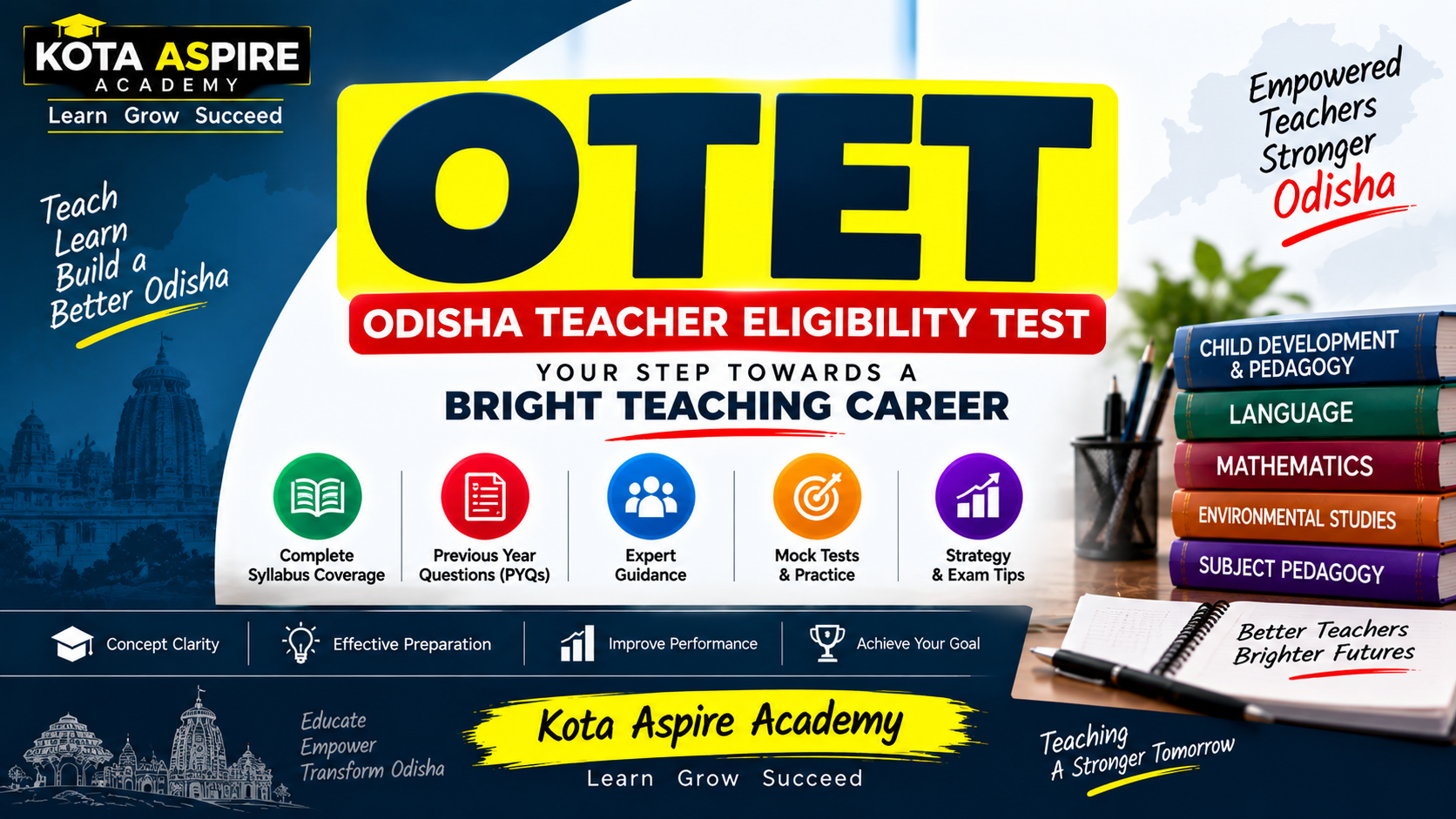
**Short Excerpt:** Prepare confidently for OTET with complete syllabus coverage, Child Development & Pedagogy, Language, Mathematics, EVS, previous-year questions, mock tests, expert guidance and an exam-focused strategy designed to help you achieve success in the Odisha Teacher Eligibility Test.
OTET Preparation Strategy: Complete Guide to Crack OTET
The Odisha Teacher Eligibility Test, commonly known as OTET, is an important examination for candidates who are preparing for teaching opportunities in Odisha. Cracking OTET requires more than simply reading books or completing the syllabus once. A successful candidate needs a clear understanding of the examination pattern, strong conceptual knowledge, proper understanding of Child Development and Pedagogy, regular practice, previous-year question analysis, mock tests, revision and effective time management. Whether you are preparing for OTET Paper I or Paper II, the right strategy can help you prepare systematically and improve your accuracy and confidence.
OTET stands for Odisha Teacher Eligibility Test and is conducted by the Board of Secondary Education, Odisha, for assessing teacher eligibility under the applicable rules. The examination consists of two papers. Paper I is intended for candidates preparing for teaching at the elementary level, while Paper II is intended for candidates preparing for teaching at the upper-primary level. Candidates should always check the latest official notification for eligibility requirements, examination rules and other applicable conditions before applying.
The first and most important step in OTET preparation is understanding the examination pattern. According to the official OTET syllabus structure, both Paper I and Paper II contain 150 multiple-choice questions carrying 150 marks. Each question has four alternatives and candidates have to select one correct answer. The examination duration and other conditions should always be checked from the latest official notification issued for the particular OTET session.
OTET Paper I consists of Child Development and Pedagogy, Language I, Language II English, Mathematics and Environmental Science. Each section carries 30 questions and 30 marks, making a total of 150 questions and 150 marks. Language I is selected from the languages permitted under the official examination structure, while English is the Language II section. Candidates preparing for Paper I should therefore divide their preparation time between pedagogy, languages, Mathematics and Environmental Science rather than focusing on only one subject.
OTET Paper II consists of Child Development and Pedagogy, Language I, Language II English and an optional subject section. The optional section is either Mathematics and Science or Social Studies. Child Development and Pedagogy carries 30 marks, Language I carries 30 marks, Language II English carries 30 marks and the optional subject section carries 60 marks. Candidates choosing Mathematics and Science prepare Mathematics and Science within the 60-mark section, while candidates choosing Social Studies prepare History and Political Science along with Geography. The official syllabus structure should be used to identify the exact topics applicable to your examination.
The most effective OTET preparation strategy begins with the official syllabus. Before starting your preparation, download the latest syllabus and make a complete topic checklist. Divide every subject into three categories: strong topics, average topics and weak topics. This simple exercise helps you understand where your preparation currently stands. Many candidates spend too much time studying subjects they already know because those topics feel comfortable. A better strategy is to maintain your strengths while giving additional time to the areas where you are consistently losing marks.
Your complete preparation should follow a simple cycle: understand the syllabus, learn the concept, make short notes, solve topic-wise MCQs, practise previous-year questions, take sectional tests, take full-length mock tests, analyse mistakes and revise. This cycle should continue throughout your preparation. The objective should not simply be to finish the syllabus. The objective should be to convert every completed topic into correct answers in the examination.
Child Development and Pedagogy is one of the most important sections of OTET and should receive serious attention from the beginning of preparation. Important areas include child development, principles of development, stages of development, physical development, cognitive development, social development, emotional development, moral development, heredity and environment, learning, individual differences, intelligence, motivation, inclusive education, children with special needs, learning difficulties, teaching approaches, teaching-learning materials, assessment and classroom practices. Candidates should not study these topics merely by memorising definitions. They should understand how each concept applies to real classroom situations.
A strong strategy for Child Development and Pedagogy is to learn the theory first, practise application-based questions second and analyse mistakes third. For example, while studying Piaget, don't simply memorise the names of the stages. Understand what type of thinking develops during each stage and how that development affects classroom learning. Similarly, while studying Vygotsky, understand social interaction, the Zone of Proximal Development, scaffolding and the role of teachers and peers. While studying Kohlberg, understand moral reasoning and the development of moral judgement. Once the theory is clear, solve classroom-based questions that require you to apply the theory.
Inclusive education is another important area that should not be ignored. Candidates should understand the meaning and purpose of inclusive education, diversity in classrooms, children with special needs, learning difficulties, gifted and creative learners, individual differences, gender-related issues, social diversity and the role of teachers in creating an inclusive learning environment. When solving an inclusive education question, think about how the teacher can support different learners rather than selecting an option based only on discipline or rote learning.
Teaching approaches are also important for pedagogy questions. Candidates should understand the differences between teacher-centred learning, learner-centred learning, activity-based learning, competency-based learning, problem-solving approaches, cooperative learning and discovery-based learning. When a question presents a classroom situation, ask yourself which option encourages active participation, understanding, individual differences, problem solving and meaningful learning. This approach can help you eliminate options that may appear attractive but do not represent effective teaching practices.
Assessment and evaluation should also be included in your preparation. Study the purpose of assessment, formative assessment, summative assessment, assessment for learning, assessment of learning, continuous assessment, feedback, remedial teaching and the use of assessment results to improve learning. Candidates should understand that assessment is not simply about giving marks. A good teacher uses assessment to identify learning difficulties, provide feedback and improve the teaching-learning process.
Language I can become a strong scoring section when prepared systematically. Your preparation should include reading comprehension, grammar, vocabulary, sentence structure, language development, reading, writing, language teaching, assessment and remedial teaching. If you choose Odia as Language I, give special attention to Odia grammar, comprehension, vocabulary and language pedagogy. Do not prepare only grammar or only literature. Language questions require understanding as well as application.
English is Language II in OTET, so candidates should practise it regularly. Divide English preparation into grammar, vocabulary, comprehension and pedagogy. Important grammar areas can include parts of speech, tenses, articles, prepositions, conjunctions, subject-verb agreement, voice, narration and sentence correction. Vocabulary preparation should include synonyms, antonyms, word meanings and commonly confused words. Reading comprehension should be practised frequently because it improves both accuracy and speed. English pedagogy should also be studied, including language acquisition, language learning, language skills, teaching methods, assessment and remedial teaching.
For comprehension questions, don't simply read the passage and immediately select an option. First identify the main idea, important information, implied meaning and the evidence supporting each answer. If an option sounds correct but is not supported by the passage, eliminate it. Regular comprehension practice can gradually improve your reading speed and reduce careless errors.
Mathematics preparation for OTET should be based on conceptual understanding rather than only memorising formulas. Important areas include the number system, arithmetic, fractions, decimals, geometry, measurement, time, money, data handling, patterns and problem solving. Candidates should also prepare Mathematics pedagogy because the examination is not only about whether you can solve a mathematical problem. It can also test whether you understand how children learn Mathematics and how a teacher should respond to common errors and misconceptions.
Mathematics pedagogy should include children's mathematical thinking, problem solving, reasoning, common errors, misconceptions, teaching-learning materials, activity-based Mathematics, assessment and remedial teaching. Whenever you solve a pedagogy question, think from the learner's perspective. Ask how a child would understand the concept, what misconception might occur and which teaching approach would help the child learn.
Environmental Science is an important component of Paper I. Candidates should prepare topics related to family and friends, food, water, shelter, travel, things we make and do, environment and everyday experiences, along with EVS pedagogy. The most effective way to study EVS is to connect concepts with real-life experiences. For example, while studying water, think not only about factual information but also about how a teacher could help children understand water conservation through activities, observation and discussion.
Candidates preparing for Paper II with Mathematics and Science should divide the 60-mark optional section into two preparation tracks. Mathematics preparation should cover the prescribed mathematical concepts, problem solving, geometry, measurement, numbers, arithmetic, data and Mathematics pedagogy. Science preparation should include the prescribed Physics, Chemistry and Biology concepts along with scientific thinking, everyday science, experiments and Science pedagogy. The official OTET structure specifies 30 Mathematics questions and 30 Science questions under this option.
Candidates choosing Social Studies should divide preparation into History, Political Science, Geography and Social Studies pedagogy. The official structure provides 30 questions from History and Political Science and 30 questions from Geography. Instead of memorising isolated facts, try to understand cause and effect, important events, geographical concepts, maps, political concepts, society and classroom teaching approaches. This makes the subject easier to remember and helps with conceptual questions.
One of the biggest mistakes candidates make is collecting too many books. More books do not automatically mean better preparation. A practical resource combination should include the official OTET syllabus, relevant school textbooks, reliable study material, previous-year questions, quality MCQs, mock tests and your own revision notes. Choose limited resources and revise them multiple times instead of repeatedly changing books.
Previous-year questions should become a major part of your preparation. They help you understand the style of questions, difficulty level, important concepts, pedagogy patterns and common traps. Don't wait until you finish the entire syllabus before solving PYQs. Complete one topic, solve questions from that topic, analyse your mistakes and then move to the next topic. Once you have completed several topics, begin solving mixed questions.
When solving previous-year questions, don't only ask whether your answer is correct. Ask why the answer is correct, why the other options are incorrect and which concept the question is testing. This method transforms a simple question into a learning opportunity.
Mock tests are essential for OTET preparation because they help you develop speed, accuracy and examination temperament. During the beginning stage, you can take approximately one mock test per week. As your preparation improves, increase the frequency to two or three tests per week. During the final stage, regularly attempt full-length papers under examination conditions.
However, taking mock tests without analysing them is one of the biggest preparation mistakes. Suppose you score 105 out of 150. Don't simply record the score and move on. Analyse how many questions you answered correctly because you knew the concept, how many you guessed, how many you lost due to conceptual mistakes, how many were careless mistakes and how many took too much time. This analysis tells you what to improve.
Maintain a mistake notebook throughout your preparation. Whenever you answer a question incorrectly, record the topic, your answer, the correct answer, the reason for your mistake and the concept you should remember. If you repeatedly make the same type of mistake, give that topic additional revision time. Your mistake notebook can become one of the most valuable resources during the final week.
You can further classify your mistakes into four categories. The first is a concept mistake, where you did not understand the topic. The second is a memory mistake, where you understood the topic but forgot an important fact. The third is a silly mistake, where you knew the answer but made a careless error. The fourth is a strategy mistake, where you spent too much time on one question or changed an answer without a strong reason. Each type of mistake requires a different solution.
For concept mistakes, relearn the topic. For memory mistakes, add the information to your revision notes. For silly mistakes, practise reading questions carefully. For strategy mistakes, improve your time-management technique through timed tests.
A three-notebook strategy can make preparation more organised. The first notebook can be used for important concepts and short explanations. The second notebook can be used exclusively for mistakes from MCQs, PYQs and mock tests. The third notebook should contain only the information you need for final revision, such as important theories, formulas, grammar rules, frequently confused concepts and high-value facts. Keep the final revision notebook short enough that you can revise it quickly.
A 90-day OTET preparation strategy can be divided into three major phases. During the first 30 days, focus on building the foundation. Complete basic concepts, give special attention to Child Development and Pedagogy, begin Language I and English preparation and start your Mathematics, EVS, Science or Social Studies preparation according to your paper. During the next 30 days, complete the remaining syllabus, increase MCQ practice, solve previous-year questions and begin sectional tests. During the final 30 days, focus heavily on mock tests, mistake analysis, revision and weak areas.
The final 15 days should be used for consolidation rather than starting a completely new preparation strategy. Revise Child Development and Pedagogy, important language concepts, Mathematics or subject concepts, pedagogy, previous-year questions and your mistake notebook. Take full-length tests and analyse them carefully.
During the final seven days, reduce unnecessary study material. Focus on your short notes, important theories, formulas, grammar rules, important subject concepts, PYQs and mistakes from previous tests. Avoid buying new books or continuously searching for new tricks. Your goal during the final week is to strengthen the knowledge you already have.
If you have only 60 days for OTET preparation, use the first 20 days for conceptual preparation, the next 20 days for completing the syllabus and intensive PYQ practice, and the final 20 days for mock tests, analysis and revision. If you have only 30 days, prioritise Child Development and Pedagogy, important language areas, high-priority Mathematics or subject topics, pedagogy, PYQs and mock tests. A shorter preparation period requires better prioritisation rather than simply increasing the number of study hours.
A practical daily study plan can include one hour of Child Development and Pedagogy, one to one and a half hours of the main subject, 45 minutes of language preparation, 45 minutes of MCQs or PYQs and around 30 minutes of revision. This is only a framework and can be adjusted according to your available time. Working candidates or teachers may divide their preparation into shorter sessions throughout the day. Consistency is more important than studying for extremely long hours occasionally.
If you are preparing for OTET while working, don't compare your schedule with a full-time candidate. You can study for 30 to 45 minutes before work, use short breaks for vocabulary or MCQs, study for one or two focused hours in the evening and spend another 20 minutes revising before sleeping. The objective is to create a sustainable routine that you can follow for several weeks.
If you are starting your OTET preparation from zero, don't immediately begin with difficult full-length mock tests. Start by understanding the syllabus, identifying your strengths and weaknesses, learning basic concepts, solving easy questions and gradually moving toward moderate and examination-level questions. Once your foundation is strong, begin intensive PYQ and mock-test practice.
If your mock-test score becomes stuck, don't immediately buy another book. Analyse your last few tests and identify your three biggest weaknesses. For example, if your CDP score is consistently low but Mathematics is strong, increase the time spent on CDP instead of studying both subjects for exactly the same amount of time. This is called targeted preparation, and it is much more efficient than following the same timetable regardless of your performance.
Time management is another important part of OTET preparation. Develop a three-round strategy during practice. In the first round, answer questions that you know immediately. In the second round, return to questions that require more thought or calculation. In the third round, review doubtful questions and check for careless errors. Practise this system during mock tests so that it becomes natural during the actual examination.
Pedagogy questions can sometimes contain two options that appear reasonable. When this happens, think about the fundamental principles of effective teaching. Ask whether the option is child-centred, whether it promotes understanding, whether it respects individual differences, whether it encourages participation, whether it supports inclusion, whether it promotes critical thinking and whether assessment is being used constructively. These principles can help you identify the stronger answer.
Technology can also be useful during OTET preparation if used correctly. Online resources can help with concept clarification, MCQ practice, mock tests, PYQs and revision. However, constantly moving between different teachers, channels and study materials can waste valuable preparation time. Select reliable resources and follow a structured sequence instead of watching random videos throughout the day.
A powerful weekly strategy is to study and practise from Monday to Saturday and take a full-length test on Sunday. After the test, spend sufficient time analysing your mistakes and use the results to create the following week's study plan. This creates a continuous improvement cycle: Study, Practise, Test, Analyse, Improve and Repeat.
You should also set specific daily targets instead of vague goals. Instead of writing "Study Mathematics," write "Complete Fractions and solve 40 MCQs." Instead of writing "Study CDP," write "Complete Piaget and solve 30 application-based questions." Specific targets make your preparation measurable and help you identify whether you are actually progressing.
At the end of every day, spend a few minutes reviewing your preparation. Ask yourself what you learned, what you practised, what mistakes you made, what needs to be revised and whether you completed your target. This simple daily review can prevent your preparation from becoming disorganised.
The 80/20 principle can also be applied to OTET preparation. Your highest-value activities should generally be understanding the official syllabus, building concepts, studying pedagogy, solving PYQs, practising quality MCQs, taking mock tests, analysing mistakes and revising. Spending several hours watching motivational or strategy videos is not equivalent to solving and analysing quality questions.
Your complete OTET preparation should follow one simple cycle: Learn, Practise, Test, Analyse, Revise and Repeat. For example, you study a CDP topic, make short notes, solve MCQs, practise PYQs, take a topic test, analyse your mistakes and revise the topic again after a few days. The same process can be applied to Mathematics, English, Odia, EVS, Science and Social Studies.
Candidates targeting a high score should focus on four major factors: accuracy, syllabus coverage, speed and revision. Accuracy prevents unnecessary mistakes. Syllabus coverage ensures that major areas are not completely ignored. Speed allows you to complete the examination comfortably. Revision ensures that previously learned concepts remain available when you need them.
Do not measure your preparation only by the number of hours you study. Measure it by the number of questions you can answer correctly, the number of mistakes you have eliminated and the improvement in your mock-test performance. A candidate who studies for five focused hours and improves every week can be in a much stronger position than someone who studies for ten hours without analysing their performance.
During the examination, remain calm and follow the strategy you developed through mock tests. Read every question carefully, avoid spending too much time on one question and return to difficult questions later. Make sure you follow the latest instructions mentioned in your admit card and the official examination notification.
After qualifying OTET, remember that eligibility qualification and actual teacher recruitment are separate processes. Qualifying the eligibility test does not automatically guarantee a teaching appointment. Candidates should continue monitoring relevant teacher recruitment notifications and check the eligibility, selection process and other requirements of the recruiting authority.
Therefore, candidates preparing for teaching careers in Odisha can use OTET as one part of a broader preparation strategy. Depending on their goals and eligibility, they can also prepare for relevant teacher recruitment examinations and selection processes.
The complete OTET preparation roadmap can be remembered in a simple sequence: Official Syllabus, Concept Building, Short Notes, Practice, Previous-Year Questions, Sectional Tests, Mock Tests, Mistake Analysis, Weak-Area Improvement, Revision and Final Testing.
The most important lesson is that OTET preparation should not be random. You don't need hundreds of books, thousands of videos or an unnecessarily complicated timetable. You need the right syllabus, reliable study resources, strong concepts, regular practice, previous-year questions, mock tests, detailed analysis and disciplined revision.
Your final OTET preparation formula should be: Official Syllabus + Strong Concepts + Child Development and Pedagogy + Language Practice + Subject Preparation + PYQs + MCQs + Mock Tests + Mistake Analysis + Revision = Strong OTET Preparation.
OTET is not won by studying everything once. It is won by understanding the important concepts, practising questions repeatedly, learning from mistakes and improving your performance every week. Start with a clear plan, follow it consistently and let your mock-test performance guide your preparation.
Kota Aspire Academy
Learn. Grow. Succeed.